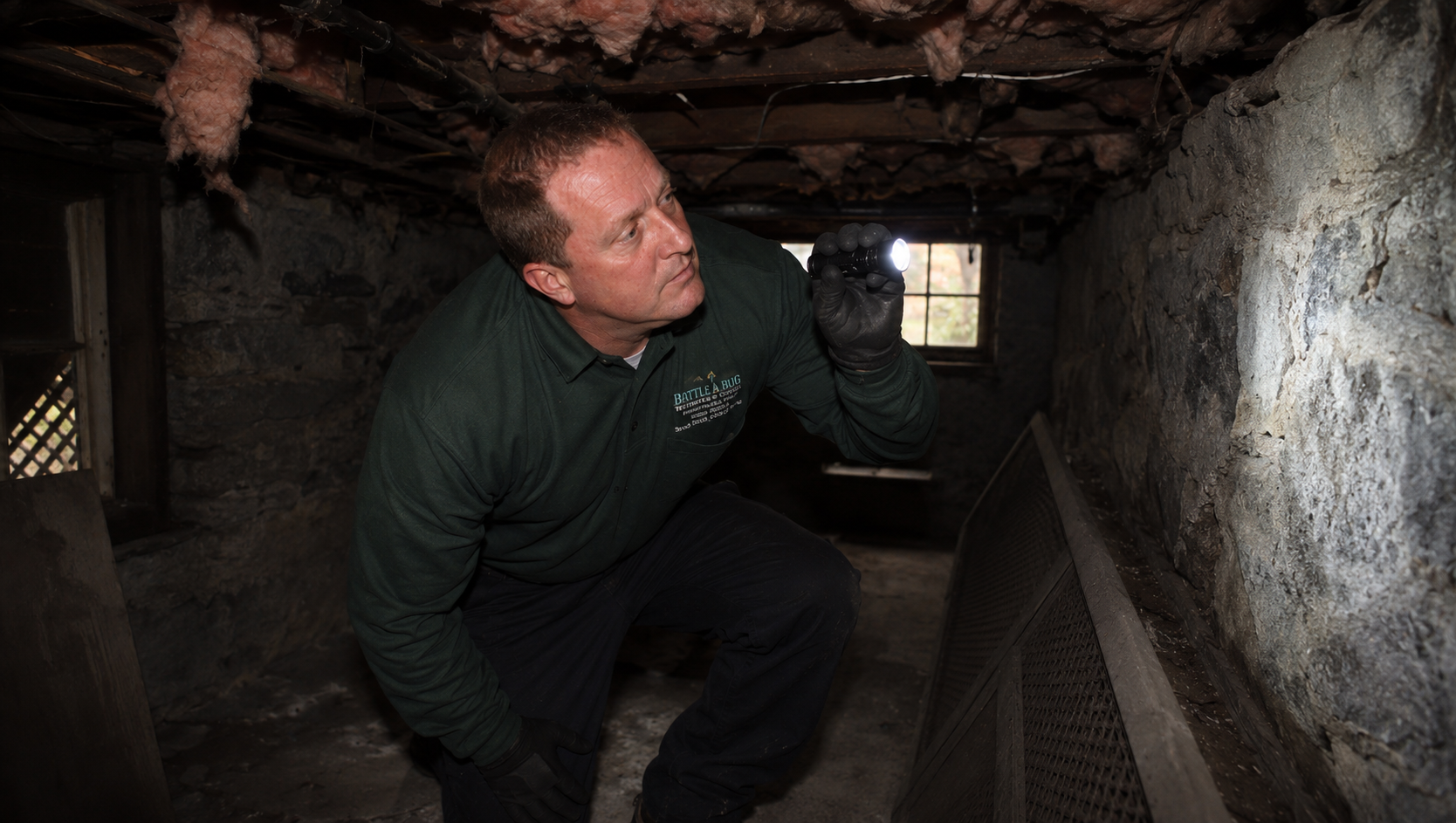
Camel crickets in your basement, or field crickets chirping through the night — we find the infestation, treat it at the source, and keep it gone. Serving Nassau County and Western Suffolk County since 1996.
Family Owned Since 1996NYS Licensed & InsuredSafe for Children & Pets
What's the fastest way to get rid of crickets in my basement?
Camel crickets and field crickets are the two types Long Island homeowners encounter most. Camel crickets — commonly called spider crickets or cave crickets — thrive in the damp, dark spaces that older Nassau County homes provide in abundance. Store-bought sprays kill the crickets you see, but leave entry points open, moisture conditions unchanged, and new crickets moving in continuously. That's why DIY treatments provide days of relief, then the population rebounds.
Professional cricket control identifies the species, locates harborage zones and entry points, and applies non-repellent insecticides and baits that work where store sprays can't reach. They move through treated areas and transfer the product to others — reaching populations hidden in crawlspaces and wall voids that a surface spray never touches. Battle A Bug has controlled cricket infestations for Nassau County and Western Suffolk County homeowners since 1996, with quarterly maintenance that keeps populations suppressed year-round.
Year-round
active indoors across Nassau & Suffolk
Since 1996
serving Long Island homeowners
Same Week
inspection scheduling across Nassau & Suffolk
Don't ignore it
Spider crickets cause real damage — and they're not going away on their own
Unlike field crickets that migrate in seasonally, camel crickets are permanent indoor residents. Once established in a basement or crawlspace, they reproduce year-round in Long Island's heated homes, chewing through stored clothing, fabric, insulation, and cardboard while populations grow unchecked.
Fall Peak entry seasonLate summer and fall bring the heaviest outdoor-to-indoor migration — but camel crickets are already indoors year-round. There's no off-season.
Moisture #1 attractantDamp basements, crawlspaces, and garages are prime cricket habitat. Reducing moisture is the single most effective prevention step alongside professional treatment.
Year-round Indoor populationsCamel crickets don't need outdoor warmth. Once inside a heated structure they remain active and reproductive through winter.
Long Island pest facts70%of camel cricket calls come from homes with moisture issues in the basement or crawlspace
Spider crickets can jump 3 feet when startled — commonly mistaken for spiders
They chew through fabric, clothing, and stored items in unfinished basements
Populations double quickly in humid, undisturbed spaces
Standard store sprays push them deeper into the structure rather than eliminating them
Long Island's older housing stock is particularly prone to the damp crawlspaces they prefer
Know your cricket
Common crickets found on Long Island
Correct species identification is the first step in effective treatment. Each cricket type nests differently and requires a different control approach.
01Camel Crickets
Most common basement species
Camel Crickets
The most frequently encountered cricket on Long Island — homeowners commonly call them spider crickets or cave crickets, but camel cricket is the correct name. Wingless, humpbacked, brown-gray, with extremely long hind legs. They don't chirp or bite, but jump suddenly when disturbed, which startles homeowners into thinking they're spiders. They thrive in basements, crawlspaces, garages, and utility rooms — any space that's dark, damp, and undisturbed. They chew on fabric, paper, and stored items, and reproduce prolifically in humid conditions. Nassau County's older homes with unfinished basements are prime habitat.
The familiar black chirping cricket — most active late summer through fall as temperatures drop and they seek warmth indoors. Unlike camel crickets, field crickets are primarily outdoor insects that migrate inside seasonally. They enter through door gaps, foundation cracks, and around utility lines. The chirping — produced by males rubbing their wings — makes them easy to detect but hard to locate precisely. Large fall invasions are common across Long Island, and while they prefer the outdoors, they'll establish in basements and crawlspaces if conditions are favorable.
Late summer–fall migrationChirpingOutdoor-to-indoorFoundation entry
02
Why crickets keep coming back
Why DIY cricket treatments don't last
Hardware store sprays kill what you see — but the conditions that brought crickets in remain completely unchanged. Moisture, entry points, and harborage zones stay open, and new crickets move in as fast as you spray them out.
Sprays repel — they don't eliminate
Most consumer products are repellent-based. Crickets detect the chemical, avoid the treated area, and move deeper into the structure. The population survives and continues reproducing in untreated zones.
Entry points stay open
Without addressing moisture and the overgrown vegetation that gives crickets a staging area at your foundation, new crickets migrate in year-round — with the heaviest pressure in fall. Spraying without fixing conditions is a cycle, not a solution.
Hidden populations survive
Camel crickets concentrate in dark, undisturbed harborage zones — behind insulation, under stored items, inside wall voids. Surface treatments don't reach them, so the core population keeps rebuilding.
The infestation cycle
You're treating the symptom, not the source
80%
of recurring cricket infestations are driven by unaddressed moisture and landscape conditions that no spray can fix
Professional cricket control inspects for and addresses the root causes — moisture, harborage, and entry points — alongside non-repellent treatment. That's what breaks the cycle for good.
What to expect
Our cricket inspection & treatment process
Every job starts with a thorough inspection — we find where they're living, how they're getting in, and what's keeping them there.
Step 01
Inspection & Species ID
We inspect the basement, crawlspace, garage, utility rooms, and exterior entry points. Species identification comes first — camel crickets and field crickets have different harborage patterns and require different treatment approaches.
Step 02
Non-Repellent Treatment & Baits
We apply professional-grade non-repellent insecticides and baits to interior harborage zones and the exterior perimeter. Non-repellents work because crickets can't detect them — they move through treated areas and transfer the product to others, reaching populations hidden in crawlspaces and wall voids. Baits are placed in key harborage zones to knock down populations quickly.
Step 03
Quarterly Maintenance
We walk you through moisture reduction and landscape conditions, then schedule quarterly service. Professional materials carry ~90-day residuals — four visits per year maintains a continuous barrier with no gap window for re-infestation.
Commercial service
Cricket control for Long Island businesses
A cricket infestation in a warehouse, restaurant, or retail space isn't just a nuisance — it's a liability. Spider crickets damage inventory and stored goods. Field crickets entering a food-service facility can trigger inspection failures. Battle A Bug provides discreet, thorough commercial cricket control across Nassau and Western Suffolk County.
We work around your operating hours to minimize disruption, with service records and documentation available on request for compliance purposes.
Restaurants & Food ServiceHealth code compliance, perimeter and interior treatment
Warehouses & StorageInventory protection, crawlspace and loading dock treatment
Retail SpacesDiscreet service to protect merchandise and customer experience
Office BuildingsRecurring maintenance plans for commercial properties
Homeowner guide
How to prevent cricket infestations
Professional treatment eliminates the population — these steps help keep it from coming back.
Reduce basement moisture
Camel crickets need humidity to survive. A dehumidifier in the basement, fixing pipe leaks, and improving crawlspace ventilation removes the primary condition that sustains indoor populations year-round.
Trim vegetation away from the foundation
Overgrown shrubs, ground cover, and tall grass directly against the foundation give crickets a shaded, humid staging area right at your home's entry points. Keep a clear perimeter and trim back any vegetation touching the structure.
Keep mulch away from the foundation
Mulch beds against the foundation hold moisture and provide harborage directly adjacent to your home. Maintain a 12–18" clearance of dry, open ground around the perimeter to reduce cricket staging areas.
Switch exterior lighting to yellow/LED
White and ultraviolet lights attract field crickets from a distance at night. Amber or yellow bulbs near entry doors dramatically reduce cricket attraction to the structure — especially useful during peak migration months.
Elevate & organize basement storage
Spider crickets target undisturbed piles of boxes, fabric, and stored items. Elevating storage off the floor and using sealed plastic bins removes both harborage and food sources, making the space less hospitable.
Start a quarterly maintenance plan
The most effective prevention is quarterly service — four visits per year timed to the ~90-day residual window of professional materials. Continuous coverage stops pressure before it becomes an active infestation, year-round.
What homeowners say
Trusted by Long Island homeowners since 1996
★★★★★
""
JL
John LV
Long Island, NY · Google Review · a month ago
★★★★★
"Great experience for all our pest control needs . Knowledgeable about all aspects of pest control. Excellent support on site and behind the scenes. Joshua, our recent on site tech was polite, professional and updated us. I recommend Victor and his team!"
DV
Diane Ventimiglia
Long Island, NY · Google Review · 11 months ago
★★★★★
"Joshua is always polite and professional."
S
Scott
Long Island, NY · Google Review · 11 months ago
Common questions
Cricket control FAQ
Answers to the questions Long Island homeowners ask most about cricket infestations and professional treatment.
What are the large jumping spiders in my basement?
Those are camel crickets — homeowners commonly call them spider crickets or cave crickets, but camel cricket is the correct name. They're wingless, humpbacked, and jump suddenly when startled, which is why homeowners often mistake them for spiders. They thrive in dark, damp spaces like basements, crawlspaces, and garages. They don't bite or chirp, but large populations cause damage by chewing on fabric, cardboard, and stored items.
Why do I have crickets in my basement year-round?
Crickets move indoors seeking warmth, moisture, and shelter — not just in fall. Heated Long Island basements and crawlspaces provide ideal conditions year-round. Camel crickets in particular are permanent indoor residents once established, not seasonal visitors. If you're seeing crickets in winter, it's an established indoor population, not a seasonal migration.
Are camel crickets dangerous?
Spider crickets don't bite humans and aren't venomous. The concern is property damage — they chew through fabric, clothing, cardboard, insulation, and stored items. A large population in an unfinished basement or crawlspace can destroy stored clothing and goods over a single season, and they reproduce quickly in moist environments. Large populations should be addressed before significant damage occurs.
Why do crickets keep coming back after I spray?
Store-bought sprays are repellent-based — crickets detect the chemical and avoid treated areas. Moisture and harborage conditions remain unchanged, and new crickets move in continuously from outside. Professional treatment uses non-repellent insecticides and baits that crickets can't avoid, combined with addressing the moisture and entry conditions that drive the infestation.
How do I get rid of crickets permanently?
Permanent control requires treating the existing population with non-repellent insecticides and baits, and reducing the moisture and landscape conditions that draw crickets in. Battle A Bug handles the treatment and inspection side and provides specific guidance on moisture and vegetation corrections. Quarterly maintenance keeps pressure suppressed before it can rebuild — the ~90-day residual window means four visits per year closes any gap.
Is cricket treatment safe for my family and pets?
Yes. Battle A Bug uses EPA-registered non-repellent insecticides applied by NYS-licensed technicians. These products are specifically chosen for their strong safety profile — in most cases family and pets can remain home during treatment. We'll advise if any brief re-entry window is needed for specific applications.
Do crickets damage my home?
Crickets don't damage structural wood, but spider crickets in particular chew through fabric, stored clothing, cardboard boxes, and insulation. A large population in an unfinished basement or crawlspace can destroy stored items over a single season. The damage is to belongings and storage, not the structure itself — but it can add up quickly in an active, undisturbed population.
How often do I need cricket treatment?
After the initial clean-out, quarterly service maintains continuous protection. The professional materials we use carry approximately 90-day residuals — four visits per year closes the gap window and stops re-infestation before it starts. This is how we treat every residential home: initial elimination, then quarterly maintenance to keep it gone.
Stop the infestation
Stop crickets from taking over your basement
We find where they're living, treat at the source, and keep them gone. Same-week inspections across Nassau and Western Suffolk County.