Trusted Long Island Pest Control Since 1996
Battle A Bug
Free Estimate →
4.9/5
★★★★★
200+ Google reviews

Wasp, Hornet
& Yellowjacket Control
on Long Island

From yellowjacket ground nests under your patio to hornet nests above your roofline — we safely identify the pest, locate the nest, and eliminate it at the source. Serving Nassau County and Western Suffolk County since 1996.

Family Owned Since 1996NYS Licensed & InsuredSafe for Children & PetsNassau & Suffolk Coverage
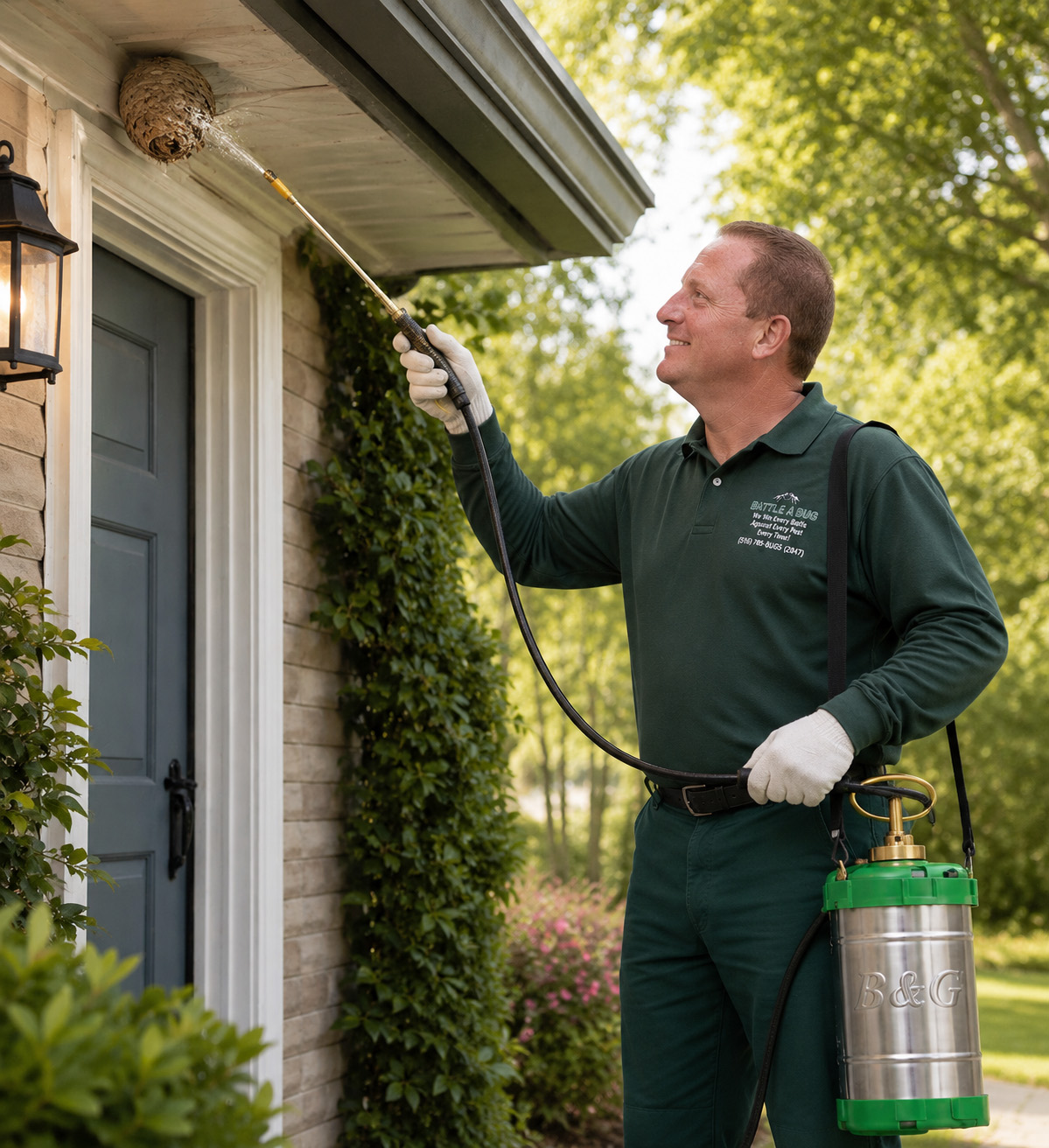
Battle A Bug technician performing stinging insect nest inspection at a Long Island home
Battle A Bug
Same-Day Service Available
Quick Answer

Think You Have Bees? You Might Have Wasps, Hornets, or Yellowjackets.

Most Long Island homeowners searching for "bee removal" are actually dealing with paper wasps, yellowjackets, or bald-faced hornets — stinging insects that look similar to bees but behave very differently and require different treatment. Battle A Bug provides professional stinging insect control and nest removal throughout Nassau County and Western Suffolk County. Our licensed technicians identify the pest, locate hidden nests — in soffits, behind siding, underground, or in wall voids — and treat the problem at its source to protect your family, pets, and outdoor spaces.

We also treat carpenter bees, which bore into wood decks, fascia boards, and siding causing structural damage that compounds year after year. For honeybee swarms or established honeybee colonies, we recommend a licensed local beekeeper for relocation. If you're not sure what you're dealing with, that's exactly what our inspection is for.

3 species
most commonly confused with honeybees on Long Island
Since 1996
serving Long Island homeowners
Same week
inspections across Nassau & Western Suffolk
Important distinction

Think You Have Bees? You Might Have Wasps, Hornets, or Yellowjackets.

The word "bee" gets applied to nearly every flying insect with a stinger — but most of the aggressive stinging insect problems homeowners deal with have nothing to do with honeybees. Paper wasps, yellowjackets, and bald-faced hornets are responsible for the vast majority of stinging incidents around Long Island homes and yards, and they behave very differently from the bees people are familiar with.

Battle A Bug treats the stinging insects that become pest problems: wasps, hornets, yellowjackets, carpenter bees, and cicada killer wasps. For honeybee swarms and established honeybee colonies, we recommend a licensed local beekeeper — those insects are best relocated alive, not exterminated.

If you're not sure what you're seeing, our team can help identify the pest and recommend the safest solution.

Know the difference4 in 5calls about "bees" turn out to be wasps, hornets, or yellowjackets — species that require pest control, not a beekeeper
  • Paper wasps build open umbrella-shaped nests under eaves, decks, and soffits
  • Yellowjackets often nest underground or inside wall voids — you won't see the nest until you disturb it
  • Bald-faced hornets build the large gray enclosed aerial nests in trees and on structures
  • Carpenter bees ARE bees — they bore into wood and cause structural damage that grows each season
  • Cicada killer wasps look terrifying but are solitary and rarely sting
  • 5,000+ workers in a peak yellowjacket colonyBy late summer, yellowjacket colonies on Long Island can reach 5,000 workers — creating serious sting risk in any outdoor living space near a nest.
  • Aug–Sept — peak aggression periodYellowjacket colonies reach maximum size in late summer, just as natural food sources decline — creating the most dangerous overlap with outdoor entertaining on Long Island.
  • Most calls about "bees" are actually waspsThe majority of stinging insect service calls involve paper wasps, yellowjackets, or hornets — requiring a pest control approach, not a beekeeper referral.
Know your pest

Common Wasps & Stinging Insects
We Treat

Correct species identification is the first step in safe, effective treatment.
Each stinging insect nests differently and requires a different approach.

Warning signs

Signs You May Have a Wasp or Hornet Nest Nearby

Stinging insect nests are often hidden — in soffits, behind siding, underground.
Here's what to watch for before the problem escalates into a sting incident.

Increased aerial activity near rooflines

Wasps and hornets repeatedly flying to and from a specific point on the roofline, eave, or soffit is the clearest sign of an active nest. You'll notice a consistent flight path entering and exiting the same spot.

Wasps entering gaps in siding or soffits

If you notice wasps repeatedly entering and exiting a gap in siding, a crack near a window frame, or a soffit opening, there is very likely a nest growing inside the wall void or cavity. These hidden nests can grow very large.

Ground holes with flying insect activity

A smooth, quarter-sized hole in a lawn, garden bed, or bare soil with insects entering and exiting is a classic yellowjacket or cicada killer ground nest. Do not fill or spray it yourself — disturbing a ground nest is dangerous.

Buzzing sounds inside walls or ceilings

Audible buzzing or a papery scratching sound from inside a wall, attic, or ceiling void during summer months is a strong indicator of an active nest inside the structure. The colony can grow considerably before any exterior sign appears.

Visible paper nests under eaves or in shrubs

Open honeycomb-surfaced nests (paper wasps) or large enclosed gray paper nests (bald-faced hornets) in trees, under decks, or attached to structures are active nests that should not be disturbed or knocked down by hand.

Aggressive behavior near food or outdoor dining

Yellowjackets repeatedly dive-bombing food, drinks, or garbage during outdoor gatherings signals a nearby colony — often within 200 feet of where you're sitting. This behavior peaks in August and September and won't resolve on its own.

Don't risk it

Why DIY Wasp & Hornet Removal Can Make Things Worse

Wasp and hornet sprays from the hardware store are designed for quick surface kills on exposed individual insects — they're not formulated for active nests, and a disturbed colony is an extremely dangerous colony. Here's what typically goes wrong with DIY attempts.

The risk in numbers

A disturbed yellowjacket nest can produce hundreds of stings in under 10 seconds

500K+
emergency room visits from stinging insect reactions in the US annually — yellowjackets are responsible for the majority

Professional treatment uses protective equipment and professional-grade products specifically designed for active nests — eliminating the colony safely while keeping your family and technician protected.

Aggressive swarming response

Yellowjackets detect an attack on their nest within seconds and release alarm pheromones that recruit the entire colony to defend. A disturbed ground nest can produce hundreds of stings before a person can retreat — this is especially dangerous for anyone with a venom allergy.

Consumer sprays miss the colony core

Store-bought sprays treat the entrance or exposed nest surface. The core of the colony — the queen, brood, and majority of workers — is deep inside the structure and completely unreached. The nest is partially disturbed but not eliminated, and surviving workers are highly defensive.

Partial treatment disperses the colony

A disturbed but surviving colony may relocate to a harder-to-reach location: deeper inside a wall void, further underground, or into an attic space. This makes subsequent professional treatment significantly more difficult and costly.

What to expect

Our Stinging Insect Control Process

Every job starts with an inspection — not a default spray. Here's exactly what we do and why each step matters for safe, complete elimination.

Step 01

Inspection & Identification

We inspect the full property to locate all active nests and identify the species. Paper wasp, yellowjacket, bald-faced hornet, carpenter bee, and cicada killer wasps all nest in different locations and respond to different treatment approaches — correct identification before treatment is essential.

Step 02

Targeted Treatment

We apply professional-grade insecticides directly to active nesting areas using the appropriate method for the nest type. Aerial nests, ground burrows, wall voids, and soffit nests each require a different application strategy for safe, effective elimination.

Step 03

Nest Removal When Accessible

After treatment, accessible nests are physically removed from the property. Removing the nest eliminates the papery structure that retains colony pheromones, reducing the likelihood of new queens selecting the same site the following spring.

Step 04

Prevention Recommendations

We identify the conditions around your property that attract nesting insects — gaps in soffits, weathered wood, ground burrow conditions, proximity to food sources — and give you specific recommendations to reduce future nesting pressure before next season.

Commercial service

Stinging Insect Control for Long Island Homes & Businesses

Wasps and hornets in a commercial setting are more than a nuisance — they're a liability. A yellowjacket nest near an outdoor dining area, school entrance, or retail storefront can injure customers and employees within seconds of being disturbed. Battle A Bug provides professional stinging insect control for businesses throughout Nassau County and Western Suffolk County, with same-week response for active nesting situations.

We work around your schedule to minimize disruption and provide documentation of all treatments on request. Our licensed technicians understand the compliance requirements for food-handling, education, and public-facing environments.

Restaurants & Outdoor DiningProtect patrons and staff from yellowjackets near seating and food service areas
Schools & DaycaresChild-safe treatment protocols and priority scheduling for active nest situations
Office BuildingsNest removal from rooflines, loading docks, and entryways with minimal disruption
Retail SpacesDiscreet same-week service to protect customers and storefront appearance
Property ManagementMulti-unit residential and commercial building programs across Nassau and Suffolk
Apartment ComplexesCommon area and exterior nest removal for tenant safety and liability reduction
Long Island summers

Stinging Insect Problems Peak During Long Island Summers

Paper wasps begin building nests in April and May as temperatures rise. By June and July, colony sizes are growing rapidly and rooflines, decks, and soffits become active nesting sites across Nassau and Western Suffolk County. Yellowjacket colonies reach their maximum size of several thousand workers in August and September — exactly when outdoor entertaining is at its peak.

BBQ season, pool parties, outdoor dining, and kids playing outside coincide directly with the period of highest stinging insect aggression. Yellowjackets are especially problematic around food, sweet drinks, and garbage during late summer, when their natural food sources begin to decline and competition for calories intensifies.

If you're noticing stinging insects around your backyard, patio, or pool area — don't wait for someone to get stung. Same-week inspections are available across Nassau County and Western Suffolk County.

Where we serve

Nassau & Western Suffolk County

  • Massapequa
  • Huntington
  • Levittown
  • Melville
  • Hicksville
  • Babylon
  • Farmingdale
  • West Babylon
  • Plainview
  • Deer Park
  • Syosset
  • Lindenhurst

And all surrounding communities in Nassau County and Western Suffolk County, Long Island. Not sure if we serve your area? Call us — we likely do.

What homeowners say

Trusted by Long Island homeowners
since 1996

★★★★★
"Does a thorough job. Pays attention to all pest needs of my shop. Keeps me on my toes on how to prevent."
AC
Anthony Chinappi
Huntington, NY · May 2017
★★★★★
"Have used B-A-B for years. Greg was very thorough and easy to work with today."
WE
Wayne Elliott
Levittown, NY · May 2017
★★★★★
"Reliable, friendly, good job and excellent at what they do."
DB
Donald & Patricia Boland
Ocean Bay, NY · May 2017
Common questions

Stinging Insect Control FAQ

Answers to the questions Long Island homeowners ask most about wasps, hornets, yellowjackets, and professional nest removal.

What's the difference between wasps, hornets, and yellowjackets?
Wasps, hornets, and yellowjackets are all members of the wasp family but behave very differently. Paper wasps are slender with narrow waists and build open, umbrella-shaped nests under eaves, decks, and soffits — they're relatively docile unless the nest is directly disturbed. Yellowjackets are more compact and far more aggressive, often nesting underground or inside wall voids, and become significantly more territorial in late summer when food sources decline. Bald-faced hornets are technically a yellowjacket species that builds the large, enclosed gray aerial nests most homeowners associate with "hornets." In practical terms, the species determines where the nest is located and how aggressive the colony will be when disturbed — which is why correct identification before treatment matters.
Can you remove nests from siding or under a roof?
Yes. Nests behind siding panels, inside soffits, under roof eaves, in attic vents, and in wall voids are among the most common jobs we handle on Long Island. Accessible nests are treated first, then physically removed when it is safe to do so. Nests inside enclosed wall voids or structural cavities are treated with professional-grade products applied through the entry point the insects are using. Battle A Bug serves homes and businesses throughout Nassau County and Western Suffolk County, including jobs involving multi-story exteriors and rooflines.
Are yellowjackets more dangerous than other stinging insects?
Yes — yellowjackets are widely considered the most dangerous stinging insect in the northeastern United States. Unlike bees, yellowjackets can sting multiple times and release an alarm pheromone that signals other colony members to attack simultaneously. A ground nest disturbed by a lawnmower or foot traffic can produce hundreds of stings within seconds — far faster than any person can retreat. Stinging insect reactions send an estimated 500,000 Americans to emergency rooms each year. Their aggression increases significantly in August and September on Long Island as the colony reaches peak size and natural food sources begin to decline.
What should I do if I find a wasp or hornet nest?
Do not spray it with a consumer product and do not attempt to knock it down. Even a partial disturbance triggers an immediate defense response from the colony. Keep people and pets away from the area and take note of where the insects are entering and exiting. If the nest is in a high-traffic area near an entrance, outdoor dining space, or children's play area, call for service as soon as possible — most nests can be addressed the same week. The safest approach is to leave the nest completely undisturbed until a professional can treat it with the appropriate equipment and protective gear.
Do wasps return to old nests?
Wasps do not reuse nests from the previous season — the entire colony dies off in late fall except for newly mated queens, who overwinter in sheltered areas and build fresh nests in spring. However, queens reliably return to the same favorable nesting sites year after year. A roofline, deck soffit, or wall gap that hosted a nest last season is very likely to attract a new queen the following spring. After treatment, we recommend removing the old nest from the property and sealing gaps around soffits, siding, and eaves to make the location less appealing to returning queens.
Can stinging insects damage my home?
Yellowjackets and hornets nesting inside wall voids, soffits, or attic spaces can cause real secondary damage as the colony grows. Large colonies can reach 5,000 workers by late summer, and when the nest collapses in fall, liquefied comb material and dead insects can seep through drywall, stain ceilings, and create moisture conditions that attract future pests. Carpenter bees bore clean half-inch holes into unpainted or weathered wood — decks, fascia boards, eaves, and siding — and return to the same galleries each year, expanding the structural damage over time. Both are best addressed early, before the colony or damage has time to compound.
Do you exterminate bees?
Battle A Bug treats carpenter bees, which are a structural pest that bores into wood decks, fascia boards, siding, and eaves — causing damage that compounds over time as bees return to the same galleries each season. For honeybee swarms or established honeybee colonies, we recommend contacting a licensed local beekeeper for relocation. Honeybees are valuable pollinators and are best removed alive by a specialist who can recover the colony intact. If you're unsure what species you're dealing with, our team can help identify it and recommend the right course of action.
How quickly can you respond?
Battle A Bug offers same-week inspections throughout Nassau County and Western Suffolk County. When a nest is in a high-traffic area — near a front entrance, outdoor dining space, or children's play area — call us directly at 516-798-2847 (Nassau) or 631-425-2847 (Suffolk) for the fastest scheduling. Emergency situations involving highly aggressive colony behavior near occupied areas are given scheduling priority. We serve Long Island homeowners and businesses seven days a week during peak stinging insect season.
How much does stinging insect treatment cost?
The cost depends on the species involved, the nest location and accessibility, the property size, and whether the nest is aerial, in-ground, or inside a structural void. A single accessible paper wasp nest on a first-floor eave is a straightforward job; a large yellowjacket colony inside a wall void or a bald-faced hornet nest near a roofline requires more labor and equipment. Battle A Bug provides a free on-site estimate before any treatment — there is no guessing over the phone. Contact us to schedule your inspection.
Don't wait for someone to get stung

Don't wait until someone gets stung

We locate the nest and eliminate it safely.
Same-week inspections across Nassau and Western Suffolk County.

Get in touch

Free stinging insect inspection. Same week. No pressure.

Tell us what's bugging you and we'll get back to you the same day. No robots, no call centers — just us.

Office46 Roosevelt Ave, Massapequa Park, NY 11762
HoursMon–Sat · 8 AM – 5 PM · Sun Closed

We'll get back to you the same business day.