Trusted Long Island Pest Control Since 1996
Battle A Bug
Free Estimate →
4.9 ★
★★★★★
149 Google reviews
Occasional Invader Control · Long Island

Every September,
they show up uninvited.

Stink bugs, spiders, boxelder bugs, and ladybugs push inside Long Island homes when temperatures drop. Battle A Bug's exterior barrier treatment stops them before they get in.

NYS Licensed
Family-Owned Since 1996
Same / Next-Day Service
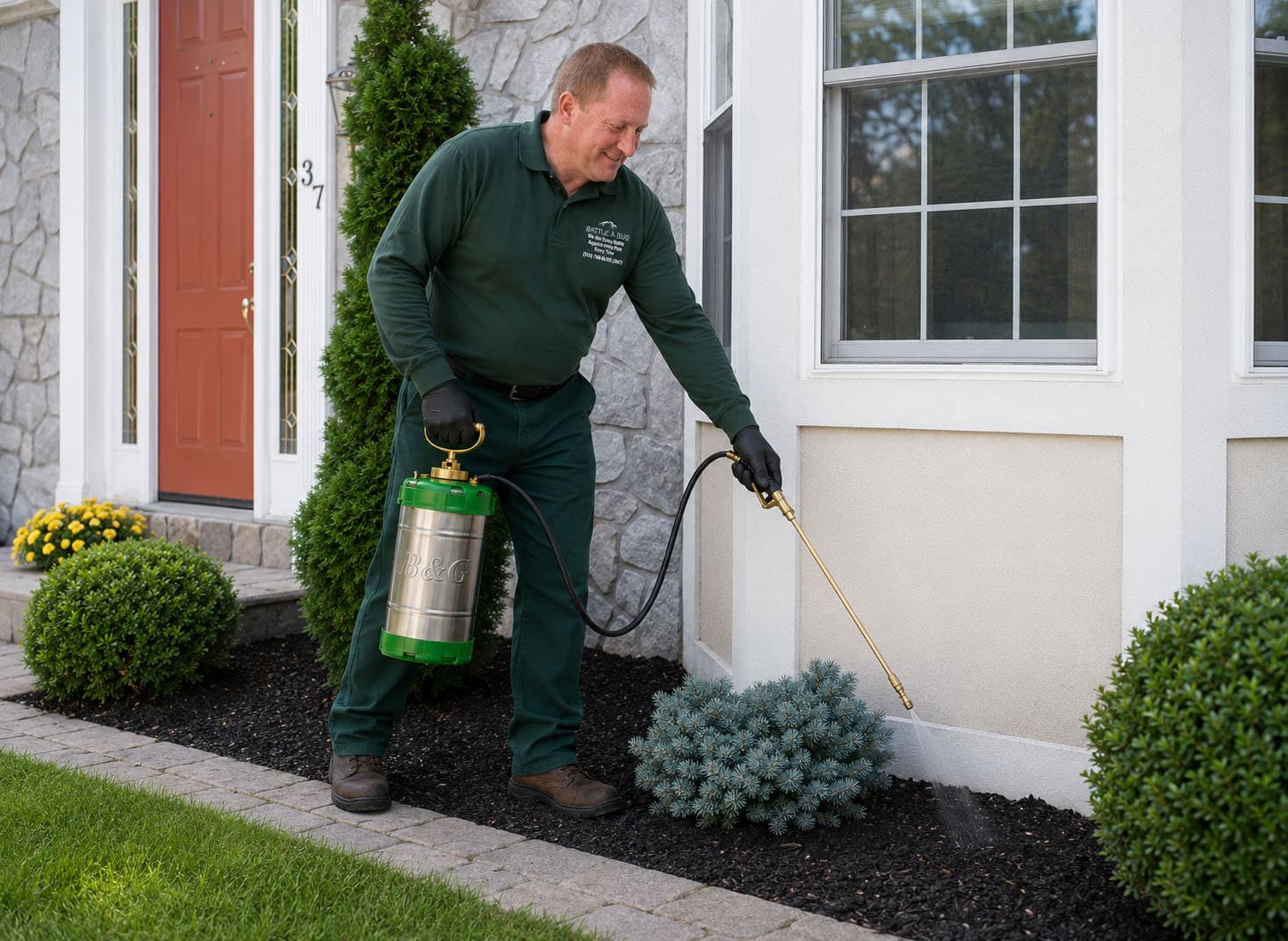
Battle A Bug technician applying exterior barrier treatment on Long Island home
Exterior Barrier
Stops them
before entry

What are "occasional invaders" and why do they appear every fall?

Occasional invaders are pests that don't live inside your home year-round — they invade in late summer and fall when the weather cools. On Long Island, the four most common are stink bugs, spiders, boxelder bugs, and lady beetles (Asian ladybugs). They're not after your food. They're after warmth. As temperatures drop in September and October, these pests squeeze through gaps in windows, siding, and foundations looking for a place to overwinter. Once they're in, they're hard to get out.

The most effective defense is a professional exterior barrier treatment applied to the full perimeter of your home before the invasion begins — typically late August to mid-September. Battle A Bug has protected Long Island homeowners from fall invaders since 1996.

Sept–Nov
Peak fall invasion window on Long Island
4 pests
Most common fall invaders we treat
Since 1996
Protecting Long Island homes
Sound Familiar?

Which ones are taking over your home?

Every homeowner we talk to in September says the same things. Pick yours.

The Long Island Fall Invader Window

September is when it begins — and when we get to work.

As nights cool down in late August and September, these pests start feeling it too. They're cold-blooded — and they know winter is coming. Your home is a warm, dry building with plenty of small gaps they can squeeze through. The race begins.

1
Late AugustStink bugs and boxelder bugs begin gathering on sun-warmed siding — you’ll see them in clusters before you feel the temperature change.
2
SeptemberThe push inside begins. Bugs find gaps around windows, utility penetrations, soffits, and foundations. This is the highest-call week of our year.
3
October–NovemberLady beetles and remaining stink bugs swarm in force. Once inside your wall voids and attic, they overwinter until spring — when they emerge from inside your walls as the weather warms.
Where they get in
4 ways fall invaders enter your home
Home entry points for fall invadersA house labeling soffits and eaves, window frames, utility lines, and foundation cracks as the ways fall invaders get inside.Soffits & eavesRoofline gapsWindow framesWorn seals & screensUtility linesPipe & cable entriesFoundation cracksBase of the walls

A barrier treatment covers every one of these before the invasion starts.

Battle A Bug technician applying exterior barrier treatment to a Nassau County home
Our Service

The exterior barrier treatment that keeps them out.

We spray a professional-grade repellent barrier around the outside of your home — around the foundation, windows, doors, soffits, and any gap we find. The product dries invisibly and lasts through the fall invasion window. It's the most effective approach because we're blocking them at the point of entry, before they ever get inside.

1
Full Perimeter Walk

We check every potential entry point — windows, doors, utility penetrations, foundation gaps, soffits, and siding seams.

2
Exterior Barrier Application

Professional-grade repellent applied to the full perimeter. Dries clear, safe for family and pets once dry.

3
Fall Protection Window

Treatment holds through the September–November invasion period. We advise if a follow-up is needed based on pest pressure.

Spiders

Spider control on Long Island: treat what they're following.

Spider control works best when it goes after what spiders are eating. The spiders we find most in Long Island homes (cellar spiders, jumping spiders, and American house spiders) are harmless, and they stick around because the insects they feed on are gathering around your foundation. Our treatment targets those insects, so fewer spiders have a reason to be there.

What we look for

On the perimeter walk, we note where webs keep building up (eaves, soffits, porch lights, window frames), where wandering spiders are getting in, and what they’re feeding on. Crickets, stink bugs, and boxelder bugs are the usual suspects in the fall.

What we treat

We apply a residual treatment around the perimeter with a backpack sprayer: under the eaves, along the foundation, around window frames, and into the cracks and crevices where insects hide. Prevention is aimed at the insects that draw spiders in, not the spiders themselves.

What to expect

Fewer insects around the house, so fewer spiders and fewer webs coming back. Inside, vacuuming the webs and checking behind furniture is usually all it takes; indoor treatment is only needed for severe problems.

When to call us

  • You’re finding wolf spiders inside every week, not just once or twice a season.
  • Webs are back on the eaves, porch, and windows within days of clearing them.
  • You’re seeing spiders and other insects: crickets in the basement, stink bugs or boxelder bugs at the windows.

Not sure what you're seeing? Which spiders are in your house this fall →

Free inspections: Nassau 516-798-2847 · Suffolk 631-425-2847

Don't wait until they're already inside.

The best time to schedule your barrier treatment is late August or early September — before the invasion starts. Once they're in your walls, the treatment changes.

Schedule your fall treatment →
What Long Island Homeowners Say

Real reviews from Nassau + Suffolk customers

★★★★★
"Great experience for all our pest control needs . Knowledgeable about all aspects of pest control. Excellent support on site and behind the scenes. Joshua, our recent on site tech was polite, professional and updated us. I recommend Victor and his team!"
DV
Diane Ventimiglia
Long Island, NY · Google Review · a year ago
★★★★★
"Joshua is always polite and professional."
S
Scott
Long Island, NY · Google Review · a year ago
★★★★★
"We have been using Battle A Bug for some time now...mostly during late summer when we seem to have yellow jacket problems. Victor's company always responds quickly to our calls and we are very pleased with the results. Victor cares about his customers and works to solve problems. When we need him to come back, he responds quickly. Let's support local family run businesses!"
AM
Ann Marie
Long Island, NY · Google Review · a year ago
Common Questions

Things homeowners ask us every September

Answers to the questions we hear most from Nassau and Suffolk homeowners.

Why do I suddenly have a ladybug infestation every fall?
What looks like a sudden ladybug infestation is almost always Asian lady beetles — and it’s not random. These pests overwinter in large groups and are triggered by dropping temperatures in late September and October. They’re attracted to light-colored siding and sun-warmed walls, which is why you’ll see hundreds on the south-facing side of your home seemingly overnight. Stink bugs and boxelder bugs follow the same pattern a few weeks earlier. Once one finds a gap, others follow — they release an aggregation signal that draws more in.
Is the barrier treatment safe for my kids and pets?
Yes. The products we use are EPA-registered and applied by NYS-licensed technicians. Once the exterior application dries — typically 30–60 minutes — the area is safe. We’ll let you know if anything specific needs a brief re-entry window.
When is the best time to schedule fall invader treatment?
Late August to mid-September is the ideal window — before the invasion starts. Treating before they enter is far more effective than treating after they’re already inside your walls. If you’re already seeing them indoors, we can still help, but the service may look different.
Why am I seeing more spiders in fall?
Spiders follow their prey indoors. As small insects push into your home for warmth in September, spiders follow. It’s also mating season: many male spiders mature by late summer and roam houses and garages looking for females, which is why sightings jump in September and October. More spiders usually signal a broader pest pressure around your home’s perimeter — the barrier treatment addresses the whole ecosystem, not just one pest.
How much does spider control cost on Long Island?
It depends on the size of your home and what else is going on around it, since spiders usually come with other insects. We start with a free inspection and give you a price before any treatment.
Are there dangerous spiders on Long Island?
Very few. The brown recluse isn’t established anywhere in New York, and calls about one inside a home are rare for us. The spiders you’ll usually find (cellar spiders, jumping spiders, American house spiders, and wolf spiders in the fall) aren’t dangerous. The northern black widow does live on Long Island, but it’s uncommon; in all his years treating Long Island homes, owner Victor Bonavita has never come across one. If you think you’ve been bitten by one, get medical care.
Do you treat spiders inside the house?
Usually it isn’t needed. Our treatment focuses on the outside of the home, where spiders and the insects they feed on live and get in. For most homes, vacuuming the webs and anywhere behind furniture where spiders are hiding takes care of the ones already inside, and we recommend that to every customer. If the problem is severe, we’ll treat inside too.
What are the black and red bugs on the side of my house?
Those are almost certainly boxelder bugs. They congregate on the warm, sunny side of homes in fall — the heat of the siding attracts them. They’re harmless but alarming in large numbers. A barrier treatment stops them from finding entry points into your home.
What are the orange ladybugs in my house — are they the same as regular ladybugs?
Those orange (or yellow) ladybugs are almost certainly Asian lady beetles — sometimes called Chinese ladybugs or Japanese ladybugs — not the native red ladybug you grew up with. The easiest tell: look for an "M" or "W" marking just behind the head. Unlike native ladybugs, Asian lady beetles swarm homes in fall to overwinter, bite mildly, and release a foul-smelling yellow stain when disturbed or crushed. If they’re in your house in October or November, they’re the Asian variety — and a barrier treatment is the right fix.
Is Battle A Bug licensed and insured?
Yes. Battle A Bug is a New York State DEC-licensed pest control business (NYSDEC Business Registration #10491), holds Suffolk County Consumer Affairs HI# 45666-H, and is fully insured. Every barrier treatment is performed by a certified pesticide applicator, and we have been family-owned and operated on Long Island since 1996.

Serving Nassau + Western Suffolk

Ready to stop the fall invasion?

Battle A Bug has been protecting Long Island homes since 1996. Call us before September and we'll take care of it before you ever see a bug inside.

Nassau · Suffolk · Massapequa · Levittown · Hicksville · Babylon · West Babylon · Farmingdale
Get in touch

Stop the fall invasion before it starts. Same or next day. No pressure.

Tell us what's bugging you and we'll get back to you the same day. No robots, no call centers — just us.

Office46 Roosevelt Ave, Massapequa Park, NY 11762
HoursMon–Sat · 8 AM – 5 PM · Sun Closed

We'll get back to you the same business day.